Biometrics
Biometrics is an emerging technology for automatically identifying individuals using
their distinct characteristics, called biometric features. Those biometric features are employed
by biometric systems to authenticate a person through automatic pattern recognition.
Related terminologies are introduced further within the following sections.
Biometric traits
Biometric traits have become applicable beyond their forensic purposes, representing
human credentials for authentication and identification purposes in the corporate, governmental
or private organisation.
Any human trait [1] can be considered as biometric
trait as long as it satisfies:
- universality: each person possesses the characteristic that the biometric identifies;
- distinctiveness: any two persons should be sufficiently different in terms of their
biometric identifiers; separating one individual from another, this property is often
termed uniqueness;
- permanence: the biometric should be sufficiently invariant over time;
- collectability: the biometric can be measured quantitatively.
Over time several human traits have turned out to be useful as biometric traits for authentication
[2]. The research is not yet completed and further progress on new unknown
biometrics is expected. New approaches and improvements on well-established
biometric methods are still in consideration.
Therefore the following overview of eight different biometrics, widely used and under intensive investigation, should be just viewed
as a collection of samples.
- DNA-Analysis:
DeoxyriboNucleic Acid (DNA) is the one-dimensional ultimate unique code for
one’s individuality; except identical twins, who have identical DNA patterns.
- Iris recognition:
Iris is the annular region of eye bounded by pupil and sclera. Visual texture of
the iris is determined by the chaotic morphogenetic process during embryonic
development. Its complex structure carries very distinctive information for each
person and each eye.
- Retinal scan:
The pattern formed by veins beneath the retinal surface in an eye is rich in structure,
stable and is supposed to be unique for each individual and each eye.
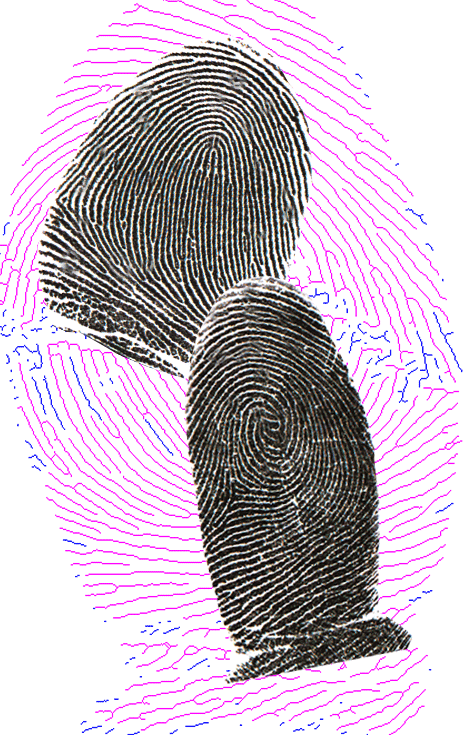
- Fingerprint recognition:
A fingerprint is an imprint made by the pattern of ridges and furrows on the pad
of a human fingertip. Its formation is determined by random processes during the
fetal period. Therefore even identical twins have different fingerprints and even
between the prints on the different fingers of an individual their is no correlation.
- Analysis of hand geometry:
A variety of measurements of the human hand including shape and lengths and
widths of the fingers can be used as biometric traits.
- Face recognition:
Face recognition is based on facial parts which do not change by facial expression.
Typically location and shape of facial attributes such as eyes, eyebrows, nose, lips,
chin shape, cheekbones and their spatial relationships are considered or overall,
global analysis of the face image.
- Voice or speech recognition:
Tone pitch, speaking dynamics and language habit characterise a person. Therefore
the voice recognition utilizes those features for analyzing the individualrelated
pattern.
- Signature recognition:
Each person has a unique style of handwriting. Geometric shape features, acceleration,
velocity and trajectory profiles of the signature are used for signature
recognition.
More about Biometric
research & issues
More about Cryptography