Cryptography
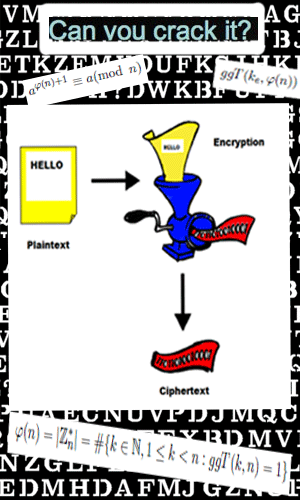
Cryptography classically refers almost exclusively to encryption. Encryption is the
process of converting ordinary information, the plaintext, into an unreadable, scrambled
ciphertext. For this purpose encryption generally requires the use of some secret
information, referred to as a secret key.
In order to recover the plaintext from the incomprehensible ciphertext, the reverse
process to encryption, familiar as decryption, is applied.
As the science of secret writing, cryptography faces the challenge of solving complex
mathematical problems. It comprises all algorithmic aspects of security where parties
interact without trusting the channels between them or even each other. Within traditional
cryptographic schemes one or more keys are employed to convert confidential
information to encrypted data. Without the knowledge of the appropriate decrypting
keys, the respective conversion of the encrypted format to the initial information is infeasible
considering time and cost limitations. This capacity has become essential
in securing commercial and government applications, communications, network
exchange, payment systems, financial services, access and identification solutions.
Cryptographic algorithms can be categorized based on the number of secret keys that
are employed for encryption and decryption, and further defined by their application and
use. The two main types of algorithms are:
- Secret Key Cryptography (SKC)
- Public Key Cryptography (PKC)
The secret key cryptography is also called symmetric key encryption, as sender and
receiver are using the same single key for encrypting and decrypting the message. In
other words, the sender uses the key to encrypt the plaintext and sends the ciphertext
to the receiver. To decrypt the message and recover the plaintext, the receiver applies
symmetric decryption with the same secret key.
It is obvious that with this form of cryptography, the secret key must be known to
both the sender and the receiver. Consequently the biggest challenge with this approach
is the secure distribution of the secret key.
Well-known secret key cryptography algorithms that are in use today include:
- Data Encryption Standard (DES)
- Advanced Encryption Standard (AES)
Public key cryptography has been considered to be one of the most significant developments
in cryptography. Whitfield Diffie and Martin Hellman described in the paper
in 1976 a two-key cryptosystem [5]. In this the sender and receiver could engage
in a secure communication over a non-secure communication channel without having
to share the secret key.
Public key cryptography depends upon the existence of so-called one-way functions.
Those mathematical functions are easy to compute whereas their inverse function is
relatively difficult to compute without the appropriate knowledge.
Public key encryption algorithms are based on the premise that each sender has a private
key and a public key. The private key is known only to the sender himself/herself,
whereas the public key is revealed to anyone. Both keys are related to the other mathematically,
such that messages encrypted with the public key can only be decrypted with
the corresponding private key. The most popular public key cryptosystem in use today
is RSA [6].
Both types of cryptographic algorithms, secret key and public key encryption, require
exactitude in key application. As highlighted earlier, there are situations in which
human factors and other sources of error undermine the potentiality of exactness. Addressing
this issue, the outlined scheme of
"The multiple control fuzzy vault" tolerates the use of inexact keys.
Biometrics within cryptographic authentication protocols
In addition to confidentiality, cryptography can also be used as a basis for authentication.
Relying on keys, cryptographic authentication protocols are either knowledgebased
or token-based authentication methods. The secrecy, randomness, and availability
of those respective keys are crucial security factors [7]. Within real-life applications
cryptographic authentication protocols are thus constrained to human abilities in
respect of storage and power of recollection. Password or PIN authentication methods
face a similar type of challenge, requiring the user to choose random sequences, change
them frequently, neither to reuse nor to write them down and remember tens of them for
different types of today’s applications.
Following those security rules of thumb, all knowledge-based authentication methods
are affected by a major disadvantage in real world applications as they only certify
authentication based on the presented knowledge of the required secret or key at the
time of transaction. None of them has the capability to confirm based on identity-proof
that the holder of the special authentication credential (either in form of key or secret)
was indeed the legitimate person. Addressing this issue, biometrics come into play.
Cryptographic property for biometric privacy maintenance
A general tool that has proved to be very applicable in a variety of modern cryptographic
protocols is the proof of knowledge. Proof of knowledge [8] is an interactive proof
protocol between two entities called the prover and the verifier. The involved commitment
function thereby enables the prover, to commit to a secret value without revealing
it. By running the protocol, the prover demonstrates to the verifier possessing of the
secret. Proving possession of secrets without revealing those secrets is thus a promising
property for maintaining privacy of biometric information.
More about "The Commitment Scheme"
More about "Biometric Cryptosystem"