Commitment Scheme
In cryptography, a commitment scheme enables to commit to a value while keeping it
secret, with the ability to reveal the committed value later. Thereby commitments bind
the party to the value in such a way that it cannot be adapted to any other messages in
order to gain inappropriate advantage.
In a conventional bit commitment scheme, two parties are involved. One is the
sender the other the receiver. The sender wants to entrust a concealed bit b to the second
party, the receiver. The commitment function allows the sender to choose the bit without
revealing it to the receiver. Later the sender is able to reveal his choice by opening the
commitment and simultaneously the receiver can use the commitment to check that
the revealed bit is correct and has not been altered. This process may be viewed as
the sender placing the bit b in a safe and giving the safe to the receiver. Only the
sender is capable of opening the safe since only he knows the required combination.
However, the sender cannot alter the bit value contained in the safe once it is in the
keeping of the receiver.
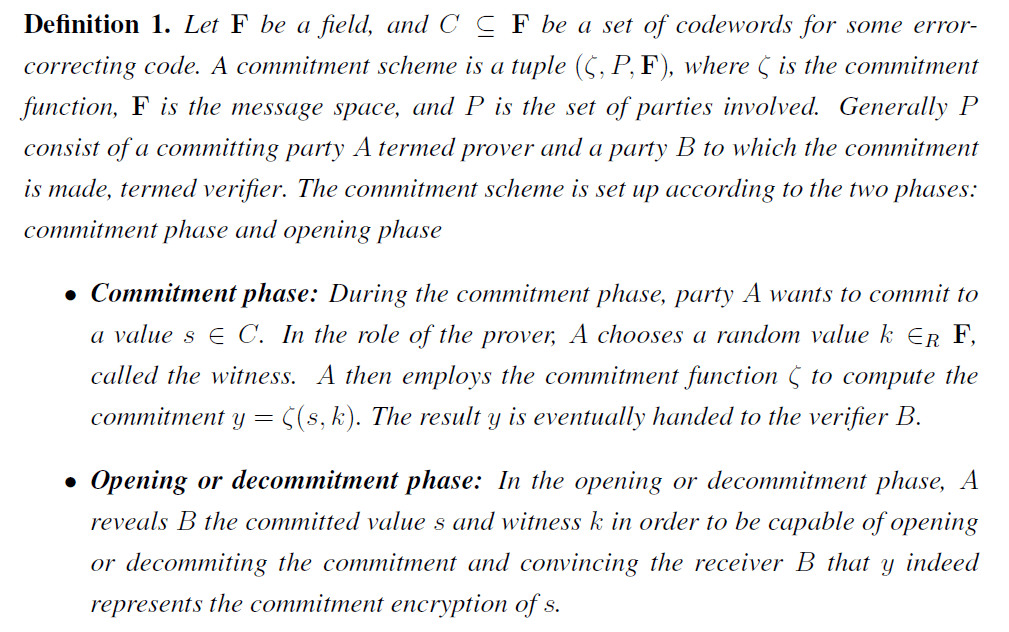
Extending the bit to a bit string, a commitment scheme formally
consists of a commitment function and two phases; the
commitment and the
opening/decommitment phase.
Representing in the later fundamental components of the introduced biometric
cryptosystem
"The multiple control fuzzy vault", the commitment scheme is
defined in more depth.
The commitment schemes is commonly integrated in error-control coding and cryptographic
techniques. The definition will thus rely on respective terminology; however in the later when integrated with
biometrics, the terms will be adjusted accordingly.
Clearly, a commitment scheme is only useful if it meets the two basic properties:
hiding and binding.
Those two essential requirements can be summarized as following:
- Hiding: The verifier B should not be able to learn the value s during the commitment
phase.
- Binding: The prover A should not be capable of altering the value s
after the commitment phase.
Fuzzy Commitment Scheme
A commitment scheme becomes fuzzy when at the stage of opening the commitment allows
uncertainties to a defined extent. Juels and Wattenberg’s scheme [9] proposed
a commitment resilient to small corruptions in the witness value k. More precisely,
the commitment y = (s; k) should be allowed to be opened using any witness k` that is
close to k in some appropriate metric such as Hamming distance. Relying on the terminology
of a commitment scheme, Juels and Wattenberg’s fuzzy commitment scheme can be defined as follows:
More about "Biometric Cryptosystem"
More about "The fuzzy vault"